 Harmonica Cheatsheet
Harmonica positions explained visually
A position is which note you treat as home on a harmonica built around a different one. Each position number moves that home note one fifth further along: second position on a C harmonica plays in G, third in D. The instrument does not change — only which of its notes is the root, and that one decision gives every other note a new job.
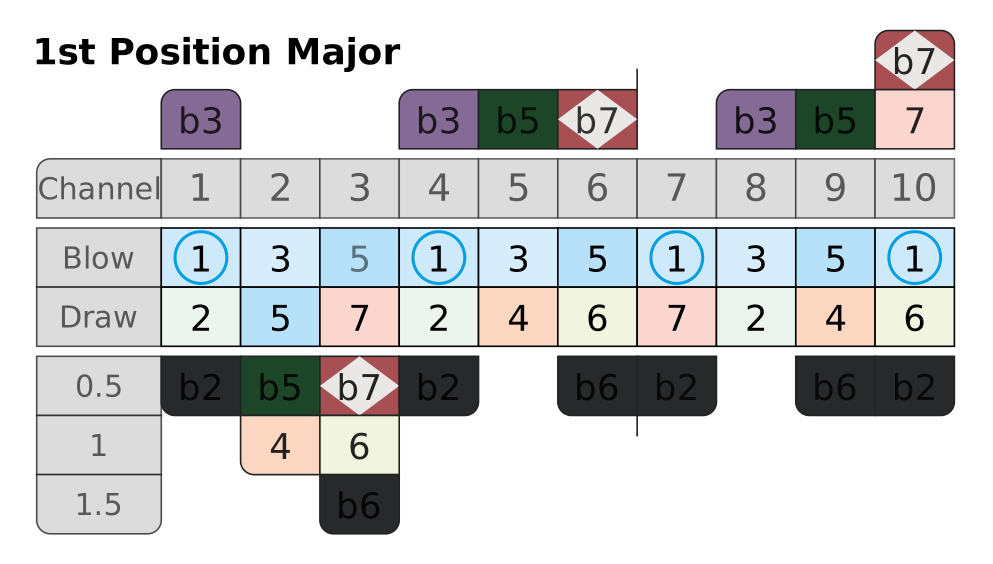
How to read one of these maps
The strip on the left names the rows. Blow and Draw are the notes you get with no technique at all; Channel is the hole numbers.
Everything above and below those two rows costs a technique, and the short vertical line between holes 6 and 7 is where the technique changes. Below the draw row and left of that line sit the draw bends, labelled 0.5, 1 and 1.5 by how far the note is bent down; right of it, the same rows hold overdraws. The two unlabelled rows at the top work the same way round: overblows on the left, blow bends on the right.
The labels are not note names but scale degrees: 1 is the home note, 3 a major third above it, b7 a minor seventh, and so on. That is the whole point of reading the harmonica this way. Note names change with every harp you pick up; the degrees do not. Learn where b7 lives in second position and you know it on all twelve keys.
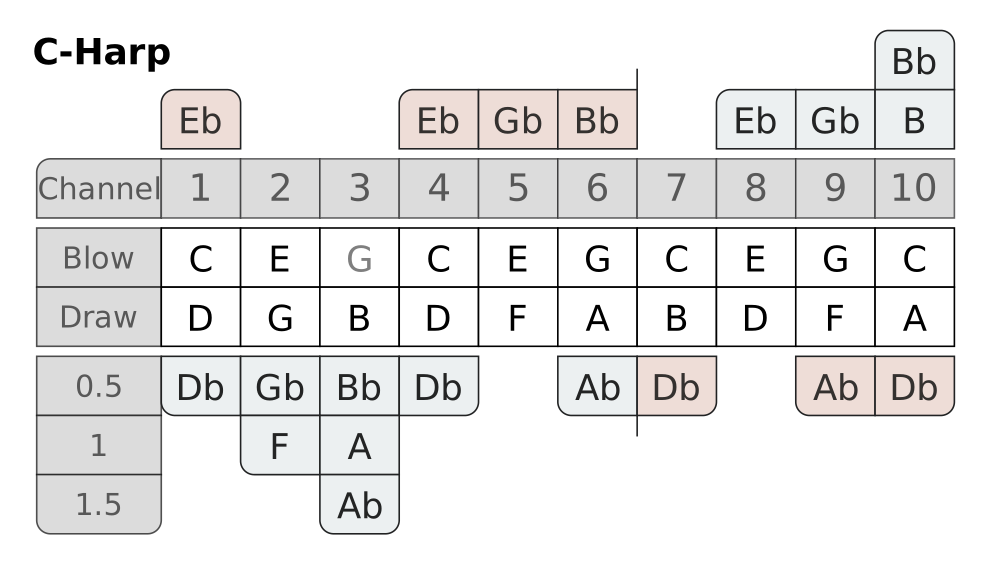
Working out the key
Positions are counted around the circle of fifths. Each step up adds seven semitones to the home note, so:
| Position | Key on a C harp | Mode you land in | Notes on it |
|---|---|---|---|
| 1st | C | Ionian (major) | “Straight harp”. Melodies, folk, anything that stays in the major scale |
| 2nd | G | Mixolydian | “Cross harp”. Blues, rock, country — the flat seventh is a plain draw note |
| 3rd | D | Dorian | “Slant harp”. Minor with a major sixth; the usual home for minor tunes |
| 4th | A | Aeolian (natural minor) | The whole scale sits under plain notes in the middle octave |
| 5th | E | Phrygian | Darker minor; the flat second is what you hear |
| 6th | B | Locrian | The fifth above the root is flattened, so nothing quite settles |
| 7th | F# | — | The root itself is not a plain note. You have to bend or overblow before you can even play home |
| 8th | Db | — | |
| 9th | Ab | — | |
| 10th | Eb | — | Same, but surprisingly interesting for major |
| 11th | Bb | — | Same, but surprisingly interesting for major |
| 12th | F | Lydian | The raised fourth is built in and gives this position its elevated touch |
Backwards works the same way. If the band plays in E and you want second position, count one fifth down from E and you arrive at A: you need an A harmonica. Third position in E needs a D harp, fourth needs G, fifth needs C.
Which harmonica for which key
The same sum for all twelve keys at once, so nobody has to count fifths on stage.
| Song key | 1st | 2nd | 3rd | 4th | 5th | 6th | 7th | 8th | 9th | 10th | 11th | 12th |
|---|---|---|---|---|---|---|---|---|---|---|---|---|
| C | C | F | Bb | Eb | Ab | Db | F# | B | E | A | D | G |
| Db | Db | F# | B | E | A | D | G | C | F | Bb | Eb | Ab |
| D | D | G | C | F | Bb | Eb | Ab | Db | F# | B | E | A |
| Eb | Eb | Ab | Db | F# | B | E | A | D | G | C | F | Bb |
| E | E | A | D | G | C | F | Bb | Eb | Ab | Db | F# | B |
| F | F | Bb | Eb | Ab | Db | F# | B | E | A | D | G | C |
| F# | F# | B | E | A | D | G | C | F | Bb | Eb | Ab | Db |
| G | G | C | F | Bb | Eb | Ab | Db | F# | B | E | A | D |
| Ab | Ab | Db | F# | B | E | A | D | G | C | F | Bb | Eb |
| A | A | D | G | C | F | Bb | Eb | Ab | Db | F# | B | E |
| Bb | Bb | Eb | Ab | Db | F# | B | E | A | D | G | C | F |
| B | B | E | A | D | G | C | F | Bb | Eb | Ab | Db | F# |
Which position you want is decided by the tune, not by the key. Major and blues: second. A minor tune with a bright sixth: third. A straight melody: first. Everything past sixth position needs a bend or an overblow just to reach the root — worth knowing it is there, not worth starting there.
Sharp keys are written with flats here, the way harmonicas are sold: a song in C# needs the harp with Db stamped on it.
What changes between positions
Compare first and second position on the same instrument. The notes are identical. What moves is where the important ones land, and how much work each one costs.
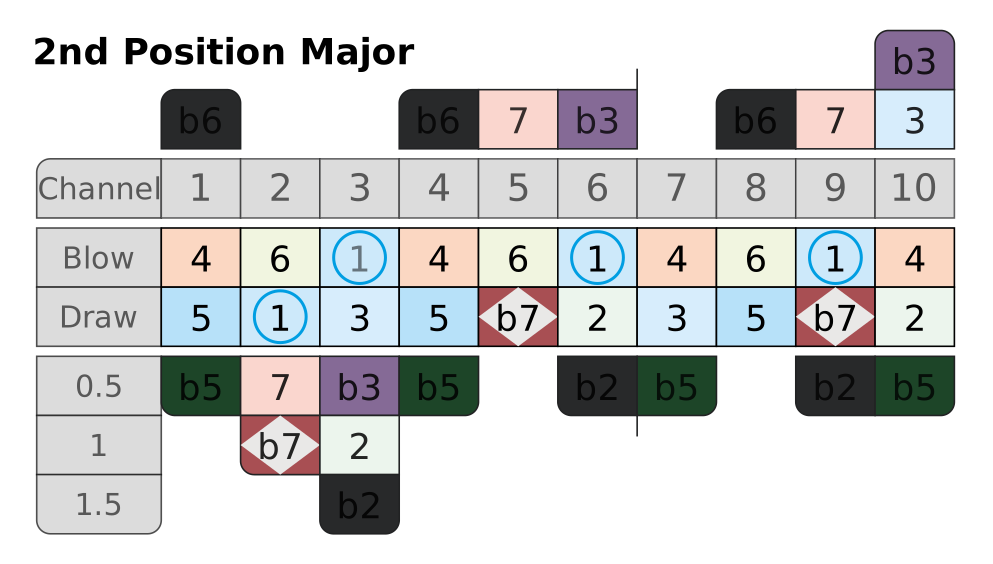
That flat seventh is most of the story. Blues, rock and a lot of country lean on the dominant seventh chord, and in second position the harmonica simply hands it to you on a draw note. In first position you would have to bend for it. The instrument is not more “bluesy” in second position; the notes a blues wants are just easier to reach.
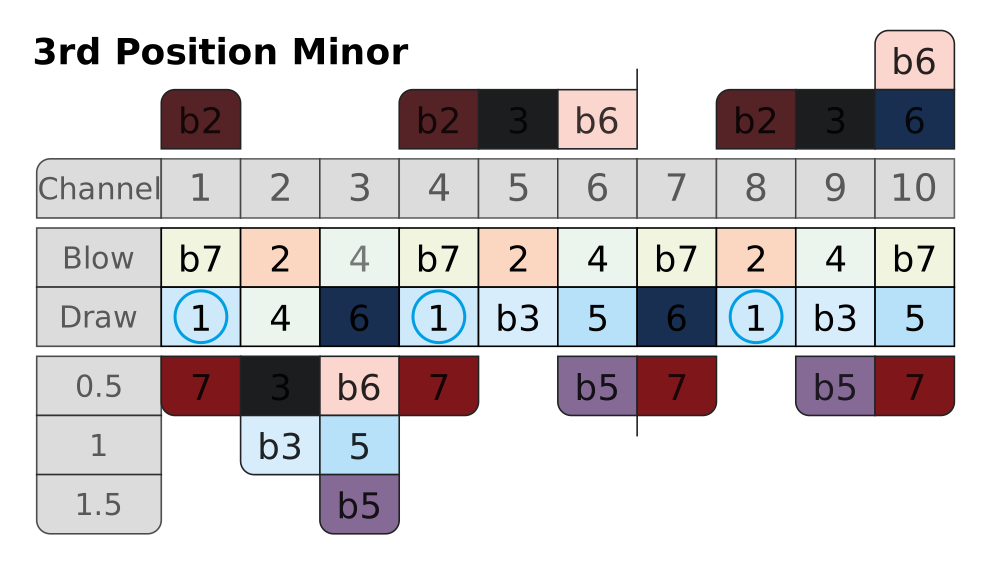
Third position moves the home note one fifth further and lands somewhere quite different:
The three octaves are not the same instrument
This took me longest to get, and it has nothing to do with which position you are in. It is simply how Richter tuning is built.
- Holes 1–4 are incomplete. On a C harmonica the bottom octave gives you C, D, E, G and B by blowing and drawing. F and A are missing until you bend: F is the whole-step bend of draw 2, A the whole-step bend of draw 3. It is one reason beginners' phrases live in the middle of the harp.
- Holes 4–7 are complete. Blow and draw alone give the whole major scale. Nothing needs a bend.
- Holes 7–10 are complete but inverted. All seven notes are there, but from hole 7 upwards the draw note is lower than the blow note. A pattern you learned in the middle octave will not transfer by moving your mouth to the right; the breathing is reversed, and the bends go the other way too — up there you bend blow notes, not draw notes.
So “the same scale degree in the octave above” can mean a plain draw note in one place and a blow bend in another. Seeing all the octaves at once is the fastest way to stop being surprised by that.
Practice: find one function everywhere
- Take any harmonica and decide on second position. Play the root in every octave you can reach: draw 2, blow 3, blow 6, blow 9. Listen for the moment the timbre changes as you cross into the top octave.
- Now do the same with the flat seventh: draw 5, draw 9, and the whole-step bend of draw 2. The same job three times, and three completely different things to do with your mouth.
- Repeat with the major third: draw 3, draw 7, and the blow bend on hole 10. This one is worth the trouble, because the third is what tells a listener whether you are in major or minor.
- Only then play a scale. It will feel different, because you now know what each note is for.
A common misconception
“Second position is the blues position and third position is the minor position.” That is a good rule of thumb and a poor rule. Position numbers do not carry a mood. (Even if they move the sound in that direction.) What they carry is a particular arrangement of easy notes and hard notes, and different music finds different arrangements convenient. Plenty of great blues is played in first, third and twelfth position; plenty of minor tunes work in fourth or fifth. If you choose a position by the label rather than by which notes you actually need, you will sometimes make the tune harder than it has to be.
The useful question is not “which position is this style in” but “which notes does this tune lean on, and where do they fall”.
The same map for your own harmonica
Everything above is one harmonica in three positions.